Author name: achuka@gmail.com

Journal

Another Taster

I have just posted another story taster to the ARIGNI Writing Room.

I am pleased with the way  material about characters from ARIGNI 1 has been accumulating. So far I have stories started (and some finished) for Yulia, Tina, Amalia, Giovanni, and Gibson’s brother.

In fact, the story about Gibson’s brother was finished earlier in the year, not during the current burst of writing. I would particularly welcome feedback on that story, so will post all 5k words to the Writing Room once there are readers there.

Journal

A Good Writing Week

I can report that I had a good writing week. Developing back-history stories for two of the characters in ARIGNI. These won’t necessarily find their way into the screenplays for ARIGNI 2. They could, but it’s likely they won’t. And that’s OK because, alongside the book-length versions of ARIGNI 1 and ARIGNI 2, I am now thinking of producing a set of short stories featuring the characters from that world, but not necessarily set in that world.

The storylines I worked on this past week involved Amalia and Yulia and experiences that they have in their home towns between the summer just past in ARIGNI 1 and the summer to come in ARIGNI 2.

I was asked during a walk this afternoon if I was writing straight into screenplay format. I’m not. I’m doing a handwritten first draft then typing it into iAWriter. As the scenes are conceived televisually from the start, and dialogue driven, the move into screenplay format will be straightforward. It’s the move into book format that may require extra texture in the form of new writing. ARIGNI 1 started out as a work of prose fiction, so the opposite was required there, with texture such as characters’ own thoughts having to be stripped away or conveyed differently.

This time I am working very much as a screenwriter, albeit the formatting will not strictly be in place until the words are transferred to Highland Pro. That won’t be until the whole story of ARIGNI 2 has been written, because I am writing as a storyteller who wants the series arc (the story being told in the full six or however many episodes) to have the coherence of a novel.

I still intend to share early drafts and process notes with the small Patreon circle I set up last week. Look out for a taster of one of the new stories in the coming days.


Review

Storytelling360

Storytelling360 logo

Storytelling360 was founded by Zack Gutin (of ThinkAlike Media and a former Final Draft VP) in 2025 as an organisation that holds high-profile conferences and events in (so far) Los Angeles, New York and London.

I attended the London event in the summer just past. It was held at the BFI on the South Bank on Sunday 12 July 2026 with a UK-heavy lineup that included Richard Gadd, Gurinder Chadha, Philip Barantini, Joe Barton, Matt Charman, and Neil Marshall. A number of names who hadn’t been pre-advertised also made excellent panel contributions.

Storytelling360 sells tickets for both live and online attendance at these events. The ticket price includes 3-months online access to the recorded stage talks. After I had attended the London event I was offered very advantageous terms for a full year’s access to all past and future talks.

This was an excellent deal. Not only can I now replay all the sessions from the BFI day I attended in person, I’ve also been able to catch up on two recent StorySocial events, one with the Broken Lizard team, held in NY, and the other with Ben Kronengold & Rebecca Shaw, creators of the Friends-style comedy show Adults.

What’s more, I can now look forward to having online access to the upcoming State of the Story conference to be held in New York at the Directors Guild Theater, 10am–5pm this Sunday, October 4 2026.

I’ve been very very careful how I’ve spent my money while branching out this late in my writing career. I have Scottish blood so financial prudence comes naturally. It soon became abundantly clear to me that it would be easy to blow literally thousands of dollars/pounds on courses, webinars, pitch sessions, script notes etc. in the space of a few months. I’ve seen evidence of people doing just that and apparently getting no further along with their careers.

I’m not a great in-person schmoozer and networker so I’ve been prioritising getting connected on online forums such as Stage32 (see previous review) and LinkedIn. I consider what I spent on my Storytelling360 London ticket plus the small upgrade fee for full online access to have been excellent value for money.

The calibre of the people Zack manages to book for the conference days and the social event sessions is top class. A recent session with Michael H. Weber was riveting and it prompted me to post the following: “Gosh, that was so good. He was on a roll and I loved the way he kept going with the Q&A while the set was being taken down behind him. So much in it, I’m sure I’ll be giving it a rewatch some time.”

There are currently very few such contributions on Zack’s site, but it’s a young platform and the comments sit behind the login so perhaps it’s not surprising. I reckon it will change as more people attend, upgrade their membership and the library of material expands.

Zack kicked off the London event by stating that his goal is to give people the chance of  hearing from people who are on the frontlines of the craft that they’re pursuing, and that’s what the London event delivered. The panels (two in the morning, two in the afternoon) featured agents, producers and screenwriters. All of them spoke about their first steps into the industry before launching into a general discussion steered by skilful moderators. The day ended with a keynote appearance from Sir Stephen Frears, now aged 85, and prone to giving the sort of brief, no-nonsense answers men in their ninth decade of life feel liberated to give. It wasn’t an easy gig for film critic Jason Solomons who was doing the questioning, but he handled the occasion brilliantly.

At the stage I’m at — an experienced writer but new to the workings of the film/tv world — I found the two morning sessions most helpful. If the event ever comes back to London (hopefully next year) I’ll attend again. Perhaps next time, (and this is a bit of boring housekeeping feedback for Zack) a welcome cup of coffee could be arranged. The South Bank was pretty dead at 9am on a Sunday (the advertised check-in time) and as the BFI’s own cafe didn’t open till 10, we all ended up queueing at the river facing bar where a single person was having to serve dozens of orders. A good networking opportunity you could say, but some of us need that first coffee of the day to get going.

Bottom line: I’ll attend in person again if there’s another event in London and I’d advise other screenwriters cautious about their spending to strongly consider becoming members.


Review

Stage 32 – A Good Place to Start?

So there I was — coming up to a year ago now — having just decided that Arigni, the novel I had been working on, was really a story to be seen rather than read. A story for screen.

But my only contacts were in the books world. I knew no one working in film and TV. That’s a slight untruth. I had done a photoshoot with a Spanish woman who is an up-and-coming cinematographer. I once taught (in primary school) someone who is now directing documentaries about the makers of horror films. Nothing beyond that, though.

While I set about turning Arigni into a screenplay, I began searching online for suitable forums to join. The first I tried was Stage 32, and it remains one of the most useful. [I will be reviewing my experience of others in due course.]

I’m writing this principally for anyone who finds themselves in a similar position: needing to get up to speed with a world with which they are unfamiliar.

A little general background about the site first.

It’s a US-based social network. [I’ll come on to the timezone problems that creates for European members in due course.] It was founded in 2011 by Richard “RB” Botto, a hugely likeable writer, actor and entrepreneur who still keeps up a regular engagement with the site, though Amanda Toney is the more active managing director. She has been there with RB more or less since the early years.

I’m able to describe RB as hugely likeable because he frequently features in webcasts and posts regularly to the forums. His motivational Sunday reflections are always worth reading.

The site claims some 1.5 million registered accounts, which sounds impressive but is somewhat meaningless when you consider that this will include people who registered years ago and are no longer actively participating, if they ever did.

Those actively using the site — posting to forums and watching webcasts — will quickly become aware that there is quite a small nucleus of members who regularly engage. That’s not a criticism. It’s a reality of sites like this.

I actually found it quite helpful, in my first weeks and months, that there was a small number of regularly reappearing names I could become familiar with and add to my Network, which is now just over 100 strong.

Signing up is free. This allows you to post to the forums and interact with other members. Free members can also buy the site’s paid services. There are many of these, and that can be an issue.

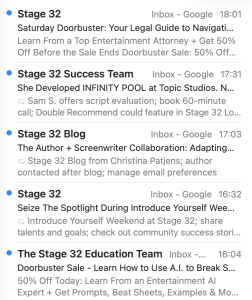
From the moment you sign up, you will receive countless inducements to send in your TV pitch bible, book your 30-minute call, take advantage of an early-bird webinar sale, and so on. I’m pretty good at resisting all this, though deleting the emails each morning can be a bit of a bore. [I’m sure there is a way I could unsubscribe.]
I’ve only used the written pitch-feedback service on a couple of occasions. I didn’t find it particularly useful. When I did so, though, I got a small member discount, because I’m a signed-up member of the Writers’ Room. This isn’t cheap. I think Stage 32 would really benefit from halving the monthly membership fee. This is a hunch, but I believe it would more than double the membership and secure greater loyalty. At current pricing levels, I suspect many people become paid-up members for just one or two months, take advantage of being able to watch the webinars, and then revert to free.

But being in the Writers’ Room for most of this year has been really, really helpful — especially for someone in my position. I have learned so much from tuning in to the webinars, watching other members pitch their ideas, and seeing how industry execs interact with writers.

As soon as you pay your first monthly membership fee you have immediate access to the full library of webinars. Believe me, there are some gems there. One of the best recently was The Exec Hour with Jason and Jamie Neese, the twin-brother producing team who have worked on Netflix’s The Umbrella Academy and Hulu’s Cruel Summer and UnREAL. These two are so inspiring to listen to.

I also like the regular Pitch Tank sessions, in which Writers’ Room members take turns to give five-minute pitches to invited film execs.

This brings me on to timezone differences. To participate from the UK in these Pitch Tank sessions would mean staying up until 1am or later. No problem for some, I’m sure. But my writing/working regime is a strict one and depends on regularity. I work 7-11am, and 6-9pm and I don’t break that for a 1am pitch.

There is an online meetup expressly designed for the European timezone, but even this, especially during British Summer Time, is not at a work-friendly hour. I realise that’s my problem, not Stage 32’s, but it may be something for others in the European zone to bear in mind.

Those caveats aside, I’m aware that I’m painting a broadly positive picture of Stage 32 based on my own experiences of the site.

However, I feel bound to draw attention to its worryingly bad rating on Trustpilot where it currently scores only 1.3, with reviewers raising issues ranging from an inability to close down an account and stop receiving emails, failure to deliver promised paid services, and execs not turning up for booked zoom calls.

These negative reviews are not new. I was aware of them when I joined the site and they’re one of the reasons I don’t use the site for their paid services.

If you’re in the position I was in a year ago — in other words, you’re new to screenwriting and need to start networking and getting a feel for how things operate in the world of film and TV – opening a free account on Stage 32, interacting in the forums for a bit, and then possibly spending a couple of months in the Writers’ Room (one month of which would be free) could definitely be a first step.

If you ever get tempted to pay someone for a script read or to pitch to, I would first check their background in IMDbPro and/or LinkedIn, both of which I will be talking about in a future post.

Do comment below if you have positive experiences of Stage 32 you’d like to share.

Journal

Two Big Editing Jobs Have Landed

As luck would have it, just when I would ideally be concentrating on ARIGNI 2 and adding content here on Story for Screen, two large editing jobs have landed — ones I couldn’t say no to.

They are both novels. One for a longstanding client, a New Orleans author who writes complex historical time-slip stories set in his home city. The second for a new author, who is hoping his story may one day be filmed (he has a film directing background) — so you can see why I could not refuse that one.

As for ARIGNI 2, I have decided that a start I made on it in the early part of the summer was heading in a wrong direction. It involved introducing a new group of characters who would have been far too interesting in their own right, especially in terms of the dynamics between them. So, I’m going to be starting again and putting that group of characters aside for the time being and maybe using them in the future for a feature script or even a TV comedy drama.

This doesn’t mean that things will be completely quiet here. I’m going to start reviewing the online platforms I’ve been using over the past 12 months to try and get myself up to speed with the world of film and TV (having previously only really known the books world), beginning with a review of Stage 32.

Journal

Updates

There have been some updates on arigni.co.uk

The screen snippets were originally photographs of sections of the script printout. They were OK but I decided it would be much better to have them coded into the html and formatted to screenplay conventions. It makes them more readable on different viewing formats and means I can swap them around from time to time.

I have also been busy doing a fresh redrafting of the first episode following some helpful notes received from Mere Walton. In particular, she pointed out that I was — in my inexperience and naivety — emulating many conventions from produced scripts that are out of place in a spec script. Well, you live and learn. So changes are being made.

Another change is a very slight rewording of the main logline which now reads: “A sheltered innocent holidaying abroad must be reunited with two lost duffel bags at all costs — since the consequences of failure are unthinkable.”


Journal

Ready to Roll

Last week ARIGNI and Story for Screen went live. Getting both sites named consistently, linked to each other and to Patreon, and in front of Google took more time than the launch itself. All of that is now in place.

From here  the journal can do what it was for: log progress on ARIGNI 2, give updates on ARIGNI 1, and share reflections on the multitude of sites, such as Stage 32, offering help and advice to screenwriters.

Journal

Story for Screen Launching Today

Hello, I don’t know what your August was like but mine, here in the UK, was filled with tropically hot days and family visits. It was a good time with a summer holiday feel. I didn’t get much real writing done but I did put some thought into two new websites:
https://arigni.co.uk – companion site for the ARIGNI book and screenplay (an online series bible if you will)
and this site, Story for Screen, a Journal covering all things related to screenwriting as well as news about my own pitching journey.
There’s also a Patreon (see footer) if you want access to a few extras.

Scroll to Top